How to pick a board game for your gaming group
How to Pick the Right Board Game for Your Gaming Group
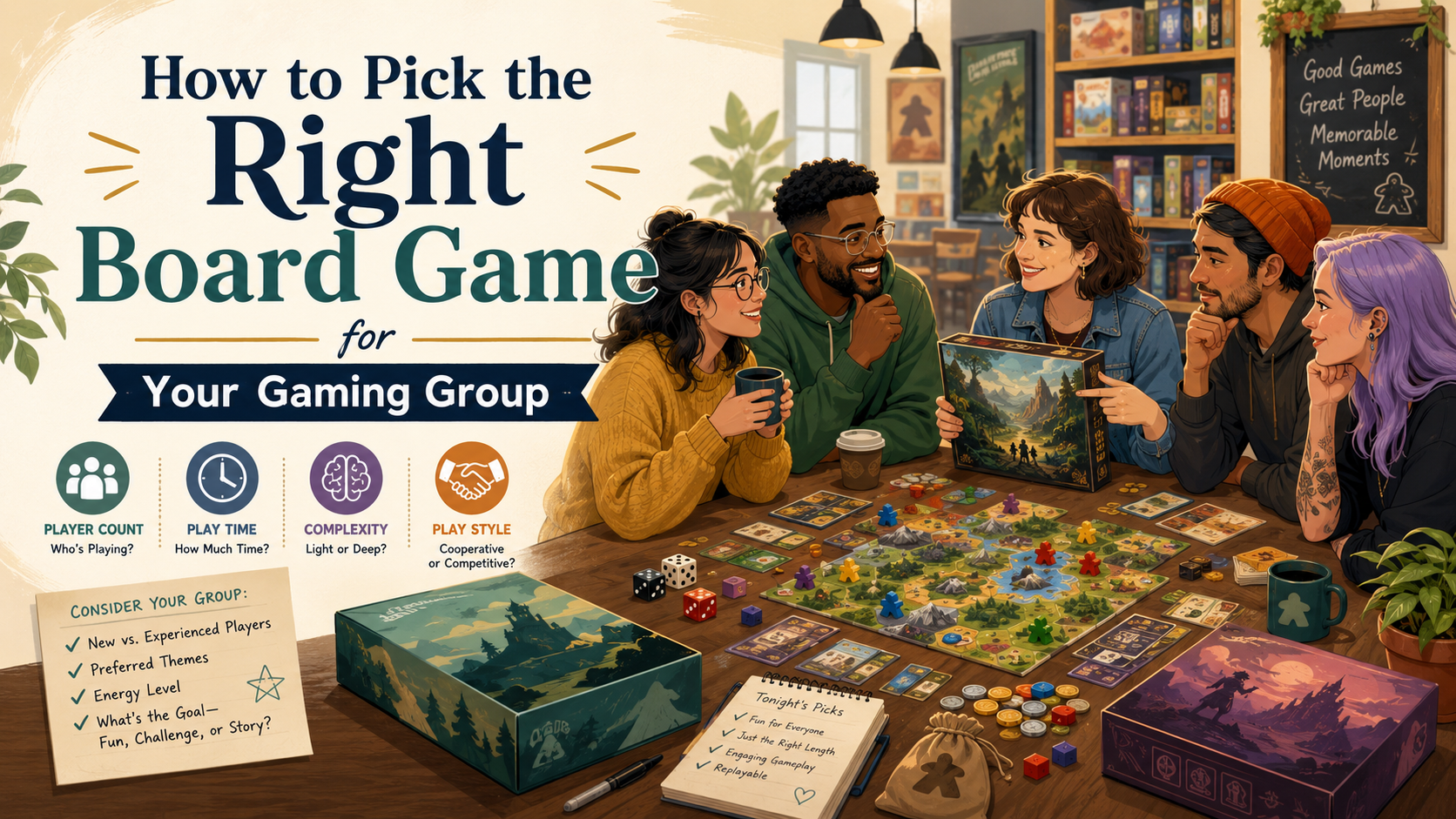
Choosing a board game should be easy. You look at the shelf, find something that looks interesting, and bring it to the table.
Unfortunately, that does not always work.
A game can have beautiful artwork, excellent reviews, and an interesting theme but still be the wrong choice for your particular group. The best board game is not necessarily the highest-rated game or the newest release. It is the game that fits the people who will actually be playing it.
Before choosing your next game, consider the size of your group, how much time you have, the experience level of the players, and the kind of experience everyone wants. Answering a few simple questions can greatly improve your chances of finding a game that everyone will enjoy.
Start With the Number of Players
The first consideration is how many people will be playing.
The player count printed on the box tells you how many people a game supports, but it does not always tell you the number at which the game plays best. A game listed for two to six players may be excellent with four players but slow or unbalanced with six.
Consider both your normal group size and how often that number changes.
A regular two-player group may enjoy games designed specifically for two people, while a family game night may need games that work well with four or five. Larger groups should look for games with simultaneous turns, team play, or limited downtime between players.
Before buying a game, ask:
- What is our usual number of players?
- Does the game work well at that number?
- Will people spend too much time waiting for their turns?
- Can the game accommodate an extra player when someone joins unexpectedly?
A game that fits your normal player count will reach the table far more often than one that only works under perfect circumstances.
Decide How Much Time You Really Have
It is easy to imagine spending an entire evening playing an epic board game. It can be much harder to make that happen consistently.
Be honest about how much time your group normally has. A game may advertise a 90-minute playing time, but the first session could take considerably longer while everyone learns the rules.
For a weeknight gathering, a game that takes between 30 and 60 minutes may be the best choice. A longer strategy game might be better saved for a weekend when no one feels rushed.
Remember to include setup, teaching, and cleanup time. A 60-minute game can become a two-hour commitment when everything is included.
It is also helpful to own games of several different lengths:
- A quick game for the beginning or end of the night
- A medium-length game that can serve as the main event
- A longer game for occasions when everyone has more time
The right game length helps keep the experience enjoyable and prevents players from losing interest before the game is finished.
Consider the Experience Level of the Players
Not every group wants the same level of complexity.
Some players enjoy learning detailed rules, planning several turns ahead, and exploring different strategies. Others want to understand the game within a few minutes and start having fun immediately.
Neither preference is wrong.
The challenge is finding a game that does not overwhelm newer players or leave more experienced players feeling unchallenged. For groups with mixed experience levels, look for games with simple rules but meaningful decisions.
Games such as Ticket to Ride, Splendor, Codenames, and Azul are often recommended because they are relatively easy to teach while still giving players opportunities to make strategic choices.
When introducing people to modern board games, avoid selecting a complicated game simply because it is one of your personal favorites. A successful first experience is more important than showing someone the most advanced game in your collection.
Start with something approachable. More complex games can always be introduced later.
Think About How Competitive Your Group Is
Competition can be exciting, but different groups react to it in very different ways.
Some players enjoy direct conflict, attacking opponents, stealing resources, and disrupting carefully prepared plans. Others prefer games in which everyone develops their own strategy with limited interference.
Before choosing a game, consider how your group handles competition.
Does everyone laugh when a plan falls apart, or is someone likely to remain frustrated for the rest of the evening? Does the group enjoy negotiation and bluffing, or would those mechanics cause tension?
Competitive games can be divided into several general categories:
- Low-conflict games: Players compete but have limited ability to directly harm one another.
- Interactive games: Players compete for shared spaces, cards, or resources.
- High-conflict games: Attacking, betrayal, elimination, or direct interference are central to the experience.
- Cooperative games: Everyone works together against the game itself.
- Team games: Players compete in groups rather than individually.
A cooperative game can be an excellent option for families, newer players, or groups that would rather celebrate a shared victory than defeat one another.
Choose the Experience Before the Theme
Theme is often what first attracts someone to a game. Fantasy adventures, space exploration, mystery, history, nature, and popular entertainment properties can all make a game stand out.
However, theme alone does not determine how a game feels to play.
A game with an exciting fantasy setting might be a quiet puzzle with very little player interaction. A game about building railroads might involve intense competition over routes. A game covered in cheerful artwork could involve aggressive take-that mechanics.
Ask what your group wants to do during the game.
Do you want to:
- Solve a mystery?
- Build an engine or civilization?
- Explore a world?
- Cooperate against a common threat?
- Bluff and negotiate?
- Compete in a tactical battle?
- Relax and enjoy a light social experience?
Choose the desired experience first, and then find a theme that makes that experience even more appealing.
Pay Attention to Downtime
Downtime is the amount of time a player spends waiting while other people take their turns.
A game may work wonderfully with two or three players but become frustrating at five or six if every turn takes several minutes. This is especially important when playing with children, large groups, or players who lose interest easily.
Games can reduce downtime by using:
- Simultaneous actions
- Short individual turns
- Team decisions
- Real-time play
- Activities that keep everyone involved between turns
Longer turns are not necessarily bad if players remain interested in what everyone else is doing. Downtime becomes a problem when players feel disconnected from the game.
Consider Whether Anyone Can Be Eliminated
Player elimination can create memorable moments, but it can also leave someone sitting at the table with nothing to do.
Before choosing a game with player elimination, consider the length of the game and the expectations of the group. Elimination may be perfectly acceptable in a fast 15-minute game. It is much less enjoyable when someone is removed during the first hour of a three-hour session.
For casual gatherings and family game nights, games that keep everyone involved until the end are usually the safer choice.
Make Sure Someone Can Teach the Game
A good game can fall flat when it is taught poorly.
Before game night, at least one person should understand the basic rules, the goal of the game, and what players can do on their turns. Reading the rulebook while everyone waits at the table is rarely the best way to begin.
The person teaching the game should be able to explain:
- How players win
- What happens during a turn
- The most important actions or choices
- When the game ends
- Any rules players need to avoid making early mistakes
Not every exception needs to be explained before the first turn. Teach enough to begin playing, and introduce smaller details when they become relevant.
Many local game stores can also provide recommendations, demonstrations, or organized events where you can learn a game before purchasing it.
Think About Who Is Actually Choosing the Game
One of the most common game-night mistakes is allowing the most experienced or enthusiastic player to make every decision.
That player may have excellent taste, but the games they enjoy may not match the rest of the group.
Give everyone an opportunity to express what they like. One player may enjoy strategy, another may prefer storytelling, and someone else may simply want a game that creates laughter.
You will not always find a game that perfectly satisfies every preference. The goal is to find enough common ground for everyone to enjoy the experience.
Groups can also rotate who chooses the game each week. This allows everyone to share their favorites and helps the group discover games it might otherwise overlook.
Try Before You Buy When Possible
Board games can be a significant purchase, especially when the group is unsure whether a particular game will be a good fit.
Before buying, look for opportunities to try the game through:
- A demonstration at a local game store
- A board game night – Three Mountain Games hosts them on Tuesdays
- A friend’s collection
- A convention or community event – Watch for our twice a year event called TMG Fest.
- A store library or game rental program
Reviews and online rankings can be useful, but playing the game is the best way to determine whether it works for your group.
A local game store can also help you compare games based on player count, complexity, playing time, theme, and interaction level. A few questions from an experienced staff member can narrow hundreds of possibilities into a manageable group of recommendations.
A Simple Board Game Selection Checklist
Before choosing a game, ask the following questions:
- How many people will normally play?
- How much time do we realistically have?
- How experienced are the players?
- How much complexity does the group enjoy?
- Do we want cooperation, light competition, or direct conflict?
- What themes interest the group?
- How much downtime is acceptable?
- Does the game keep everyone involved until the end?
- Is someone prepared to teach it?
- Is there a way to try the game before buying it?
A game does not need to meet every possible preference. It simply needs to be a good match for the people gathering around the table.
The Best Board Game Is the One Your Group Wants to Play Again
There is no single best board game for every group.
A highly rated strategy game may be a poor choice for players who want a light social experience. A simple party game may not satisfy a group that enjoys complicated decisions. A two-player game will not help much when six people arrive for game night.
The right choice is the game that fits your group’s size, available time, experience level, and preferred style of play.
When those pieces come together, the result is more than a successful game night. It becomes an experience people talk about, remember, and ask to play again.
At Three Mountain Games, we enjoy helping players find games that fit their group rather than simply pointing them toward the newest release. Whether you are planning a family game night, introducing friends to the hobby, or looking for your group’s next strategic challenge, asking the right questions is the first step toward finding the right game.