The Agenda
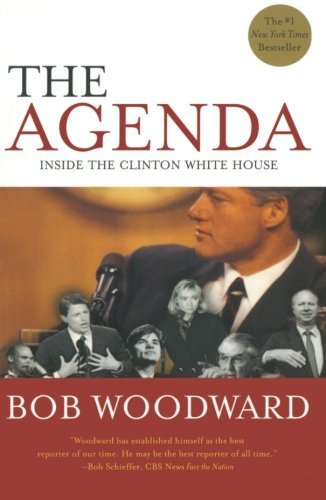
Synopsis: The Agenda is a day-by-day, often minute-by-minute account of Bill Clinton’s White House. Drawing on hundreds of interviews, confidential internal memos, diaries, and meeting notes, Woodward shows how Clinton and his advisers grappled with questions of lasting importance — the federal deficit, health care, welfare reform, taxes, jobs. One of the most intimate portraits of a sitting president ever published, this edition includes an afterword on Clinton’s efforts to save his presidency.
Pages: 384 Pages
Writer: Bob Woodward
Recommendations: All The President’s Men By Robert Woodward & Carl Bernstein

I picked up The Agenda by Bob Woodward mostly because Bill Clinton was elected right as I was becoming an adult. At that point in my life, Clinton felt unlike any president I had experienced before. He was younger, charismatic, energetic, and promising a future that sounded like it might actually improve life for families like mine: very middle class, working hard, and hoping government might still be capable of helping ordinary people.
For me, Clinton’s election was one of the first times I really paid attention to what was happening at the highest levels of government—or, honestly, at any level of government. Reading The Agenda now, decades after Clinton’s presidency, what struck me most is how much the political line has moved. At the time, Clinton was often treated as if he was too far left. Looking back from today’s political landscape, many of the ideas he pushed would likely seem much more centrist, and in some cases even a bit conservative.
That was one of the most interesting parts of the book for me. The Agenda makes it clear that even when political goals sound like they should benefit the majority, getting anything done is incredibly difficult. The book captures a frustrating truth about politics: if one side wants something, the other side often feels forced to oppose it, even when the issue itself should not be that divisive.
As a political history book, The Agenda offers a detailed behind-the-scenes look at the early Clinton administration. Woodward shows the pressure, conflict, strategy, and compromises involved in trying to shape policy. There are moments when the tension picks up, especially when major bills or decisions are on the line. Those sections give the book real energy and make the reader feel the stakes of governing.
However, the book is also a difficult read at times. Woodward fills the story with conversations between a large cast of political figures, advisors, and insiders. The problem is that the book often seems to assume the reader already knows who all of these people are, what role they play, and why they matter. Since many of the names are similar or unfamiliar, it can become confusing trying to keep everyone straight.
The pacing also suffers because so much of the book is built around one conversation after another. At times, it feels less like a flowing narrative and more like a long collection of political back-and-forths. That level of detail may appeal to readers who love deep political reporting, but for me, it slowed the book down and made it hard to stay engaged. I almost gave up at one point, but my own stubbornness kicked in because I like to finish what I start.
Overall, The Agenda is an interesting but demanding look at the Clinton presidency and the early battles over policy, power, and political compromise. It works best as a political time capsule, especially for readers who remember Clinton’s rise or want to better understand how his administration tried to govern. However, the heavy dialogue, large cast of players, and slow pacing make it a book that requires patience.
For me, The Agenda was more fascinating in hindsight than enjoyable in the moment. It gave me a clearer picture of a political era I lived through but did not fully understand at the time. Still, it was not always an easy or engaging read, and I finished it more out of determination than excitement.