Dungeons & Dragons Weapons
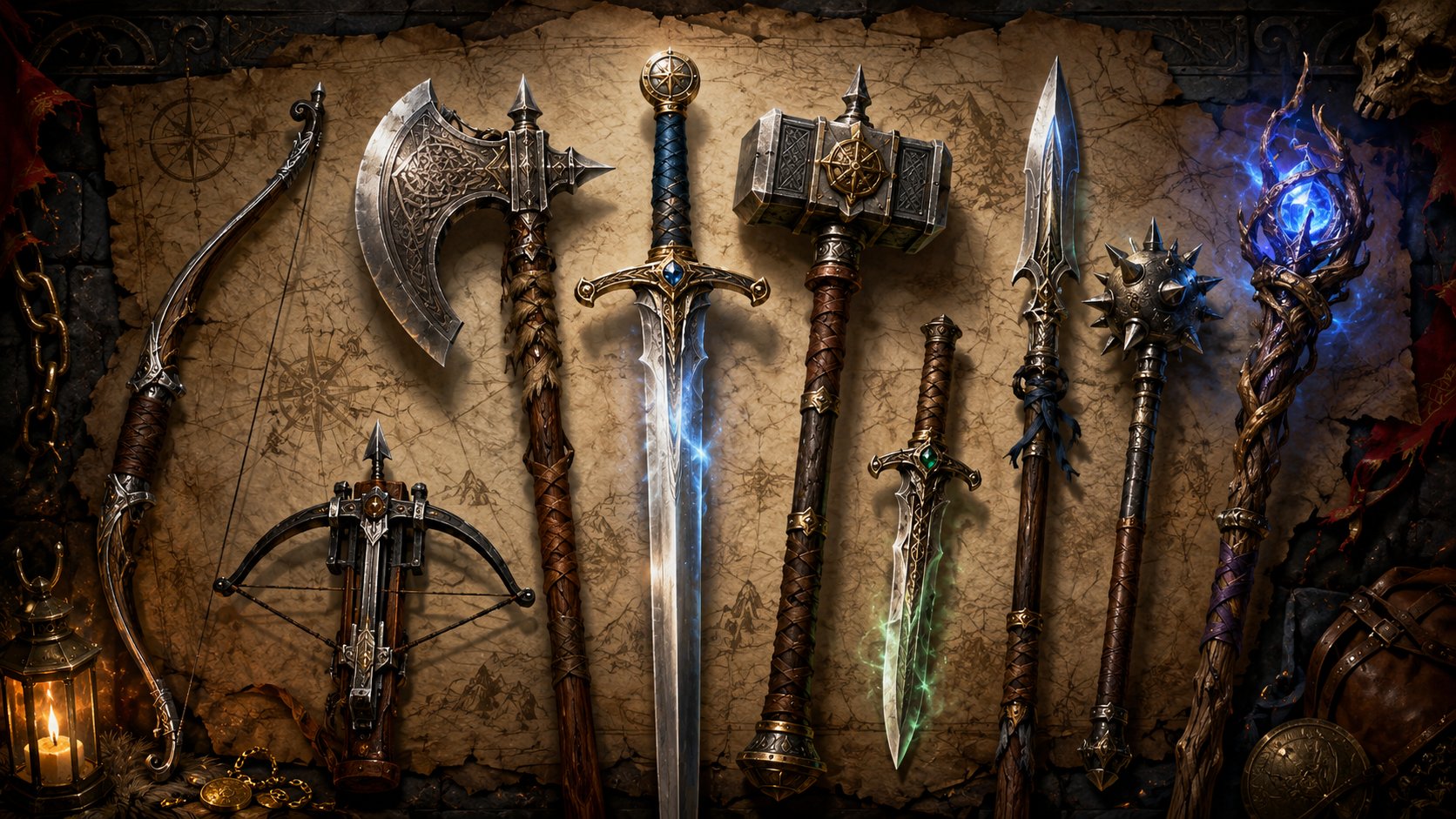
Dungeons & Dragons weapons are more than simple tools of battle—they are the legendary blades, bows, axes, and arcane armaments that help define every adventurer’s story. Whether your character is a fearless fighter charging into melee with a greatsword, a cunning rogue relying on a trusted dagger, a ranger striking from the shadows with a longbow, or a cleric wielding a sacred warhammer, the right weapon can shape both your strategy and your roleplaying style. From common starting gear to powerful magical weapons, understanding how weapons work in Dungeons & Dragons can make combat more exciting, character choices more meaningful, and every adventure feel a little more heroic.
On this page, we’ll explore the different types of Dungeons & Dragons weapons, how they are used in gameplay, and what makes each one a memorable part of your character’s journey. Whether you are building your first D&D character or looking for inspiration for your next campaign, this guide will help you choose weapons that fit your adventurer’s abilities, personality, and epic destiny.
Category: Every weapon falls into a category: simple or martial. Weapon proficiencies are usually tied to one of these categories.
Melee or Ranged: A weapon is classified as either melee or ranged. A melee weapon is used to attack a target within 5 ft, whereas a Ranged weapon is used to attack at a greater distance.
Damage: amount of damage a weapon deals when an attacker hits with it as well as the type of that damage.
Selling Equipment: Equipment fetches half its coast when sold. In contrast, trade good and valuables – like games and art objects retain their full value in the market place.
Weapon Proficiency: Anyone can wield a weapon, but you must have proficiency with it to add your proficiency bonus to an attack roll you make with it. A player character’s features can provide weapon proficiencies. A monster is proficient with any weapon in its stat block.
Properties
Ammunition: You can use a weapon that has the Ammunition property to make a ranged attack only if you have ammunition to fire from it. They type of ammunition required is specified with the weapon’s range. Each attack expends one piece of ammunition. Drawing the ammunition is part of the attack (you need a free hand to load a one-handed weapon). After a fight, you can spend 1 minute to recover half the ammunition (round down) you used in the fight: the rest is lost.
Finesse: When making an attack with a finesse weapon, use your choice of strength or dexterity modifier for the attack and damage rolls. You must use the same modifier for both rolls.
Heavy: You have disadvantage on attack rolls with a heavy weapon if it’s a melee weapon and your strength score isn’t at least 13 or if it’s a ranged weapon and your dexterity score isn’t at least 13.
Light: When you take an attack action on your turn and attack with a light weapon, you can make one extra attack as a bonus action later on the same turn. That extra attack must be made with a different light weapon, and you don’t add your ability modifier to the extra attack’s damage unless that modifier is negative. For example, you can attack with a shortsword in one hand a dagger in the other using the attack action and a bonus action, but you don’t add your strength or dexterity modifier to the damage roll of the bonus action unless the modifier is negative.
Loading: You can fire only one piece of ammunition form a loading weapon when you use an action, a bonus action, or a reaction to fire it, regardless of the number o attacks you can normally make.
Range: A range weapon has a range in parentheses after the Ammunition or Thrown property. The range lists two numbers. The first is the weapon’s normal range in feet, and the second is the weapon’s long range. When attacking a target beyond normal range, you have disadvantage on the attack roll. You can’t attack a target beyond the long range.
Reach: A reach weapon adds 5 ft to your re3ach when you attack with it, as well as when determining your reach for Opportunity Attacks with it.
Thrown: If a weapon has the Thrown property, you can throw the weapon to make a ranged attack, and you can draw the weapon as part of the attack. If the weapon is a melee weapon, use the same ability modifier for the attack and damage rolls that you use for a melee attack with that weapon.
Two-Handed: Requires two hands when you attack with it.
Versatile: A versatile weapon can be used with one or two hands. A damage value in parentheses appears with the property. The weapon deals that damage when used with two hands to make a melee attack.
Mastery: Can only be used if the character has a feature, such as weapon mastery, that unlocks the property for the character.
Cleave: If you hit a creature with a melee attack roll using this weapon, you can make a melee attack roll with the weapon against a second creature within 5 ft of the first that is also within your reach. On a hit, the second creature takes the weapons damage as well but don’t add your ability modifier to that damage unless that modifier is negative. You can make this extra attack only once per turn.
Graze: If your attack roll with this weapon misses a creature, you can deal damage to that creature equal to the ability modifier you used to make the attack roll. This damage is the same type dealt by the weapon, and the damage can be increased only by increasing the ability modifier.
Nick: When you make the extra attack of the light property, you can make it as part of the attack action instead of as a bonus action. You can make this extra attack only once per turn.
Push: If you hit a creature with this weapon, you can push the creature up to 10ft straight away from yourself if it is Large or smaller.
Sap: If you hit a creature with this weapon, that creature has disadvantage on it next attack roll before the start of your next turn.
Slow: If you hit a creature with this weapon and deal damage to it, you can reduce its speed by 10 ft until the start of your next turn. If the creature is hit more than once by weapons that have this property, the speed reduction doesn’t exceed 10ft.
Topple: If you hit a creature with this weapon, you can force the creature to make a constitution saving throw (dc 8 plus the ability modifier used to make the attack roll and your proficiency bonus). On a failed save, the creature has a prone condition.
Vex: If you hit a creature with this weapon and deal damage to the creature, you have advantage on your next attack roll against that creature before the end of your next turn.